Monarch General Engineering & Liquid Filtration Products Brendale
Monarch General Engineering Services - workshop machining and fabrication

Commissioning & Start-Up Application

Commissioning & Start-Up Application

Temporary Cone Strainers for Commissioning and Start-Up

Temporary cone strainers provide a practical method of protecting pumps, valves, meters, heat exchangers and other critical equipment from construction and pipeline debris during commissioning, flushing, start-up and post-maintenance cleaning.

Monarch Asia Pacific designs and manufactures temporary cone strainers in Australia, with custom dimensions, materials, perforations, mesh linings and reinforcement to suit the application.
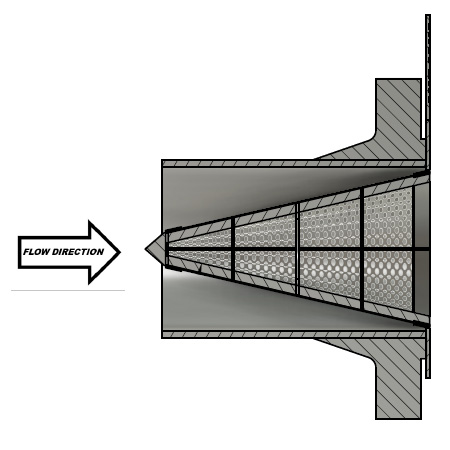
Temporary cone strainer installed for commissioning and start-up protection
Protect Equipment
Capture debris before it reaches pumps, valves and instruments.
Temporary Service
Commissioning, start-up, shutdown and system cleaning.
Custom Construction
Perforated, mesh-lined and reinforced designs available.
Made in Australia
Manufactured in Monarch's Brendale workshop.

Why Temporary Strainers Are Used During Commissioning

New or modified pipework is rarely completely free from debris. Fabrication, welding, coating, transport, installation and maintenance can leave foreign material inside the pipeline that may be carried downstream when the system is first flushed or placed into service.

Common contamination includes weld slag, rust, mill scale, gasket fragments, construction debris, coating particles and other loose solids. If this material reaches critical equipment it can damage impellers, valve seats, meters, spray nozzles, seals and heat-transfer surfaces.

A temporary cone strainer provides a removable mechanical barrier between the source of contamination and the equipment being protected. It can be installed during the cleaning and commissioning phase, inspected and cleaned as required, and removed once acceptable system cleanliness has been established.

Common commissioning debris:

  • Weld slag
  • Rust and pipe scale
  • Mill scale
  • Gasket fragments
  • Coating particles
  • Fabrication debris
  • Construction residue
  • Foreign material from maintenance work

Typical Temporary Cone Strainer Applications

Temporary cone strainers are commonly used whenever pipeline cleanliness needs to be established before normal plant operation.

Pipeline Commissioning

Capture construction and fabrication debris while new pipework is progressively brought into service.

Plant Start-Up

Protect pumps, valves, meters and other equipment during initial operation while system cleanliness is being confirmed.

Pipeline Flushing

Collect loose material displaced during water, process-fluid or other approved system flushing procedures.

Hydrotesting & Cleaning

Provide temporary equipment protection where debris may be mobilised during hydrotesting and system cleaning.

Shutdown & Maintenance

Reduce contamination risk after plant shutdowns, equipment replacement, maintenance work or pipeline modifications.

Brownfield Tie-Ins

Protect existing equipment where new pipework, branch lines or modified systems are connected to operating plant.
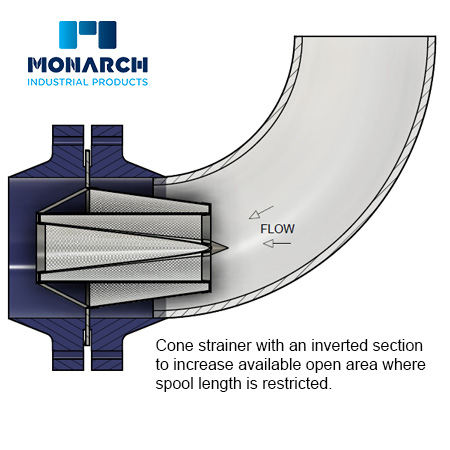
Cone strainer with an inverted section to increase available open area where spool length is restricted.

Operating Principle

How a Temporary Cone Strainer Works

A temporary cone strainer is generally installed between pipeline flanges with the screen positioned in the flow path. Fluid passes through the perforated or mesh-lined cone while particles larger than the screen openings are retained.

The conical form provides significantly more screening surface than a flat plate installed within the same pipe bore. This greater area can help reduce clean pressure drop, increase debris-holding capacity and extend the interval between inspection or cleaning.

During commissioning, the strainer is inspected and cleaned at intervals determined by debris loading, pressure drop and the project cleaning procedure. Once the system has reached the required cleanliness standard, the temporary element can normally be removed.

Image: Cone strainer with an inverted section to increase available open area where spool length is restricted.

Temporary Cone Strainer Design Considerations

Correct performance depends on effective open area, debris characteristics, mechanical strength and the allowable pressure drop.

The cone must fit the line size, flange arrangement and available installation envelope while providing sufficient filtration area for the required flow. Where installation length is restricted, a truncated cone or alternative geometry may be considered.

The required surface area should be based on the effective open area of the filtration layer. If woven wire mesh is fitted over perforated support plate, the mesh may become the controlling open area and should be considered when determining the overall straining ratio.

The screen opening should retain debris that could damage downstream equipment without making the strainer unnecessarily restrictive. Expected particle size, process requirements and allowable pressure drop should all be considered.

Differential pressure rises as solids accumulate. The cone, perforated support, mesh and reinforcement must therefore be strong enough for the intended duty. Reinforcing rings, heavier plate or additional structural support may be required for large sizes or high differential-pressure conditions.

Material is selected to suit the process fluid, temperature, corrosion environment and project specification. Common options include carbon steel and stainless steels, with other materials considered where required.

The intended flow direction, cone orientation and method of installation and removal should be confirmed before manufacture. Larger strainers may also require handling or lifting provisions to support safe installation and maintenance.

Construction Options

Perforated Plate

Strong, simple construction for coarse debris retention where the required opening can be achieved with perforated sheet alone.

Perforated Support + Woven Mesh

A structural perforated cone supports a finer woven-wire layer where smaller particles need to be retained.

Reinforced Designs

Support rings, heavier backing or additional reinforcement can be incorporated where differential-pressure or size demands require increased mechanical strength.

Alternative Temporary Strainer Forms

A conventional full cone is not always the most practical geometry. Available space, required filtration area and project installation details may favour an alternative temporary strainer arrangement.

  • Standard cone strainers
  • Truncated cone strainers
  • Truncated cones with inverted sections
  • Temporary basket strainers
  • Temporary plate strainers
  • Full-face or custom flange arrangements
Area advantage: conical and truncated-conical designs can provide substantially greater screening area than a flat plate occupying the same pipeline bore.

A Practical Commissioning Sequence

Temporary strainers should form part of the overall cleaning and commissioning procedure rather than being treated as a fit-and-forget item.

1. Install

Fit the approved strainer in the designated location before critical downstream equipment is exposed to flow.

2. Start & Monitor

Establish flow gradually and monitor operating conditions and differential pressure where available.

3. Inspect & Clean

Remove accumulated debris at intervals appropriate to the loading and allowable pressure drop.

4. Remove or Replace

Once cleanliness criteria are achieved, remove the temporary element or replace it with the permanent protection specified for normal operation.

Information Required for Design & Quotation

Temporary strainers are often project-specific. Providing the process and mechanical information at the enquiry stage helps ensure the cone has adequate area, strength and installation fit.

Monarch can work from project datasheets, drawings, sketches, existing strainer details or defined operating conditions.
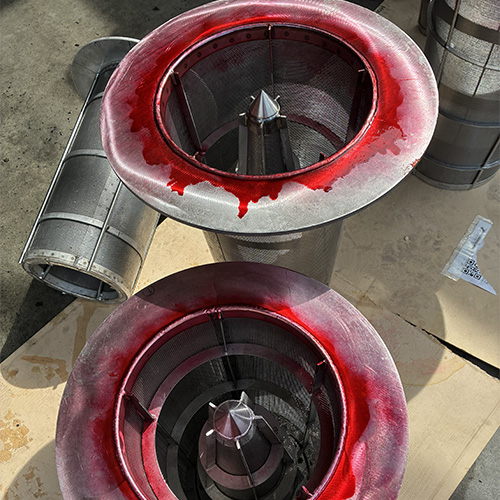
NDT is available on request and should be specified at the time of enquiry.

Useful information includes:

  • Nominal line size and pipe schedule
  • Flange standard and pressure class
  • Flow rate
  • Process fluid
  • Operating and design pressure
  • Operating and design temperature
  • Expected debris size, type and loading
  • Required perforation, mesh or micron rating
  • Required or preferred straining ratio
  • Allowable clean and dirty pressure drop
  • Material specification
  • Flow direction and cone orientation
  • Available cone length / installation space
  • Required differential-pressure resistance
  • Temporary operating duration
  • Quantity, tagging and documentation requirements
Dye Penetrant Testing (DPI) of Cone Strainer Welds

Australian Manufacture + Engineering Support

Custom Temporary Cone Strainers

Monarch Asia Pacific manufactures temporary cone strainers from our Brendale workshop, allowing us to support standard project requirements as well as non-standard sizes, urgent replacement work and specialised commissioning duties.

In-house fabrication capability allows the cone geometry, support construction, mesh lining, reinforcing and flange arrangement to be tailored to the application rather than forcing the project to suit a standard catalogue design.

  • Standard and large-diameter cone strainers
  • Truncated and special cone geometries
  • Perforated and mesh-lined construction
  • Reinforced designs
  • Carbon steel and stainless steel options
  • Full-face and custom flange arrangements
  • Project tagging and identification
  • Manufacture from drawings and datasheets
Image: Third Party Dye Penetrant Testing (DPI)

Temporary Cone Strainer FAQs

Temporary cone strainers capture construction and pipeline debris such as weld slag, rust, mill scale, gasket material and foreign solids before they can reach pumps, valves, meters, heat exchangers, nozzles and other sensitive equipment.

Temporary cone strainers are commonly installed between pipeline flanges at a location selected to protect downstream equipment while allowing inspection and removal during the commissioning or cleaning program.

Adequate effective open area helps reduce clean pressure drop, provides greater solids-holding capacity and allows the strainer to continue operating as debris accumulates.

Yes. Cone strainers may use perforated plate alone or a perforated support with woven wire mesh where finer particle retention is required. The mesh open area should be considered when determining the overall effective filtration area.

Useful information includes line size, flange standard, flow rate, fluid, operating and design pressure, temperature, expected debris type and loading, required perforation or mesh opening, allowable pressure drop, material, flow direction and available installation space.

Need Temporary Cone Strainers for a Commissioning Program?

Send Monarch Asia Pacific your line sizes, flange details, process conditions and screen requirements for review and quotation.

Discuss Your Application


"Your Reliable Brisbane Workshop for Machining, Fabrication & Repairs | Reliable Site Service | Over 25 years’ experience in Industrial Filtration"
Monarch Asia Pacific Pty Ltd
T/as: Monarch General Engineering
T/as: Monarch Industrial Products
ABN 60 141 555 688

Office and Workshop
Unit 3, 8 Bult Drive, Brendale, QLD 4500, Australia
Phone: +61 (0) 7 3889 9949
Monarch Asia Pacific Pty Ltd, © 2026 All Rights Reserved