Industrial Filtration Application
A simple and economical strainer design for applications where retained solids can be flushed through a drain connection, reducing the frequency of manual basket removal and cleaning.
Flushing basket strainers combine the larger filtration area of a basket strainer with a dedicated drain arrangement. They are particularly suited to hard, non-deformable contamination such as rust, pipe scale and similar pipeline debris.
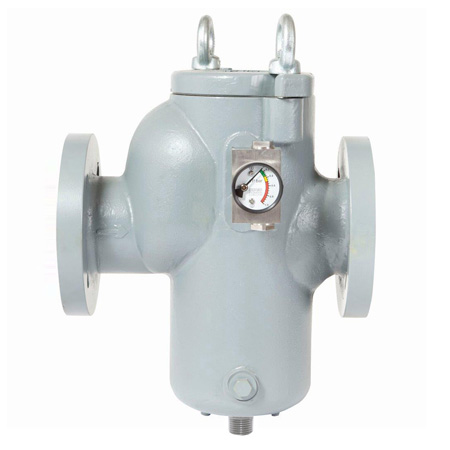
A flushing strainer is a modified simplex basket strainer designed to discharge accumulated solids through a drain connection without routinely removing the basket from the body.
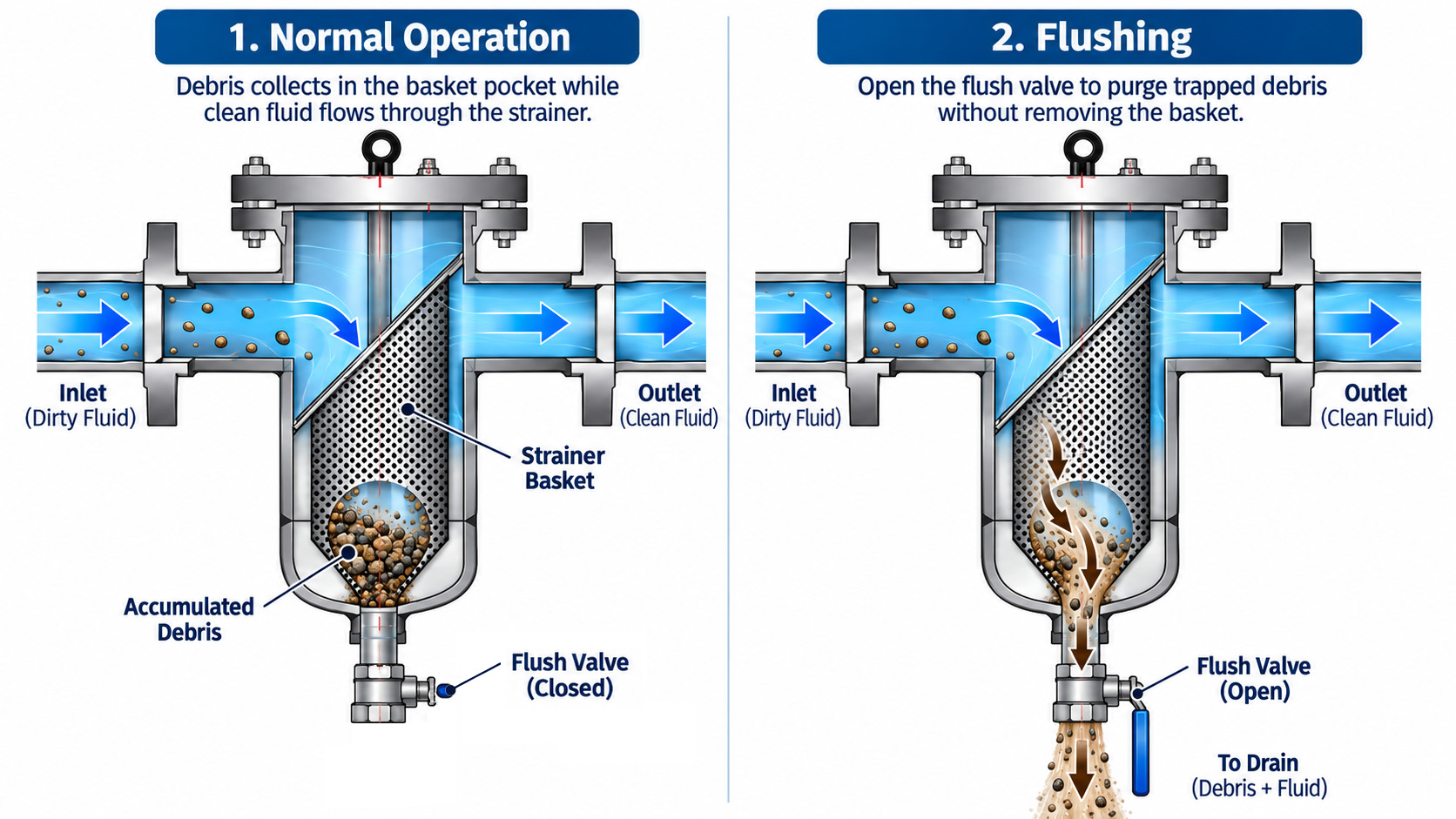
Unlike a conventional simplex basket with a closed bottom, the flushing basket has an open lower end that seals against the bottom of the strainer chamber. During normal operation, liquid enters the basket and passes outward through the perforated or mesh filtration surface, while oversized solids are retained inside the basket.
When the drain valve is opened, the pressure differential between the process line and the drain creates a high-velocity flushing flow. This helps sweep loose retained material from the basket chamber and discharge it through the drain.
Operating Principle
During normal filtration, process liquid flows into the basket and outward through the perforated or mesh surface to the outlet. Particles larger than the basket openings are retained inside the element.
When the bottom drain valve opens, liquid follows the lower-resistance path toward the drain. The resulting high-velocity flow and swirling action within the basket help move loose solids from the filtration surface and the bottom of the chamber toward the discharge connection.
The flushing cycle is normally brief, which can limit process-fluid loss while allowing accumulated solids to be removed without opening the main strainer cover.
A flushing basket strainer can provide a practical middle ground between a manually cleaned basket strainer and a more complex automatic self-cleaning system.
Loose accumulated solids can be discharged through the drain, reducing the frequency of basket removal.
The basic system consists of the strainer and drain valve, without the complexity of a full backwashing system.
Basket strainers can provide substantially more filtration area and solids-holding capacity than many Y strainers.
Fewer basket-cleaning interventions can reduce contact with hot, aggressive or otherwise hazardous process liquids.
Performance depends strongly on the characteristics of the retained solids and the available flushing pressure.
Hard pipeline contamination that does not readily deform or embed deeply into the filtration media.
Removal of larger debris before pumps, valves, heat exchangers, nozzles and other downstream equipment.
Simple manual or actuated flushing can be useful where uncomplicated operation and reduced intervention are important.
Applications with positive line pressure where a larger basket area is preferred over a conventional Y strainer.
A flushing strainer is not simply a standard basket strainer with the bottom removed. Correct sealing, particle characteristics and operating pressure are essential.
Both can provide simple blowdown or flushing, but a basket strainer generally offers a larger filtration area and greater solids-holding capacity.
| Feature | Y Strainer | Flushing Basket Strainer |
|---|---|---|
| Typical straining area | Often relatively limited | Can provide substantially greater filtration area |
| Typical area ratio | Often around 1:1 in conventional designs | Can be approximately 4:1 or greater depending on design |
| Solids-holding capacity | Lower | Higher |
| Flushing / blowdown | Available on suitable designs | Dedicated flushing arrangement |
| Typical application | Basic pipeline and equipment protection | Applications requiring greater area and reduced flushing frequency |
Straining area ratios are indicative and depend on the specific strainer design and basket configuration.
Correct selection depends on both the hydraulic conditions and the characteristics of the contamination. The strainer must provide suitable basket area, aperture size, drain capacity and material compatibility while maintaining enough pressure differential for effective flushing.
Where the application falls outside the practical range of a flushing strainer, Monarch can also assist with conventional basket strainers, Y strainers and self-cleaning filtration alternatives.
Product Supply + Practical Engineering Support
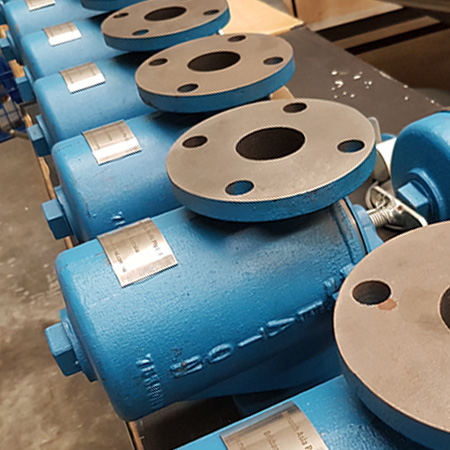
Monarch Asia Pacific combines industrial strainer and filtration experience with practical fabrication and machining capability from our Brendale facility.
We can assist with application review, basket and screen design, vessel modifications, replacement elements, fabricated supports, skid arrangements and other practical installation requirements.
Contact Monarch Asia Pacific with your process conditions, solids characteristics and filtration requirements.
Discuss Your Application